Can You Get a 2nd Trust Deed on a Commercial Property? What California Allows
What many of those same owners don’t realize is that a commercial property equity loan structured as a second trust deed is a legitimate path forward. You keep your existing first loan as it is. A second lien is placed behind it and you access a part of the equity you’ve built - without triggering a refinance, without disrupting your existing lender relationship and without the bureaucratic process that comes with conventional commercial financing.
The catch is that second trust deeds on commercial real estate aren’t as easy as their residential counterparts. The lender pool is smaller, the underwriting looks different and the terms reflect the added risk that comes with holding a junior position on income-producing collateral. That doesn’t make them impossible - it just means you’ll need to know what drives the deal and where to look. This post walks through that: how commercial second TDs work, what California lenders will and won’t do and what types of properties and borrowers have successfully used this structure to put equity to work.
Key Takeaways
- California allows second trust deeds on commercial properties, letting owners access equity without refinancing or disrupting existing first loans.
- Commercial second TDs differ from residential ones-lenders analyze rent rolls, tenant quality, and vacancy rates rather than personal income.
- Most private lenders cap combined loan-to-value between 50-70%, with anything above 65% raising significant red flags for approval.
- Fewer lenders offer commercial second position loans due to subordinate foreclosure risk, longer timelines, and lower property liquidity.
- Retail strips, mixed-use buildings, small offices, and light industrial properties with equity and occupancy are common fundable deal types.
What a Second Trust Deed on Commercial Property Actually Means
A trust deed is a security instrument - it ties a loan to a piece of property so the lender has a legal claim if the borrower stops paying. When a property already has one loan secured against it, a second trust deed puts a new lender in line behind the first. That position is called subordinate, which just means the first lender gets paid before the second lender does if things go wrong.
The second lender still holds a secured interest in the property; it’s worth something, and it’s a big part of why these loans are possible at all. The security isn’t as strong as first position, but it’s recorded.
In California, trust deeds on property are governed under the California Civil Code. The laws cover how loans are originated, how they’re serviced, and what lenders can do when a borrower defaults. Commercial properties fall under this framework too, though some residential protections don’t apply to them. If you want a broader overview of what California’s private lending rules mean for borrowers, that’s worth reviewing before you sign anything.
One recent development worth learning about: California’s AB 130, signed on June 30, 2025, introduced new laws around how servicers manage subordinate mortgages - this added another layer of regulation that lenders and borrowers on second trust deeds now have to account for. The law doesn’t stop second trust deeds from happening. But it does shape how they’re managed after the loan closes.
In simple terms, a second trust deed on a commercial property is a loan secured by that property’s equity, recorded in second position behind whatever financing is already in place. The borrower gets access to capital without refinancing the first loan. The lender gets a recorded lien and the rights that come with it.
The mechanics are easy enough. What gets more complicated is how lenders evaluate risk on a second trust deed - and how sellers and existing loan servicers each respond to a second lien being placed on the property; it’s where the California-specific facts start to matter - and where the questions come in.
How Commercial 2nd TDs Differ From Residential Ones
The mechanics change quite a bit when you move from a home to a commercial property. A residential second mortgage follows a fairly predictable path - lenders check your credit, verify your income from a W-2 or tax return, and apply standard laws. Commercial second trust deeds don’t work that way.
For one thing, the income picture is more tough. With a commercial property, the lender needs to know how the property itself generates revenue. That means looking at rent rolls, lease terms, tenant quality, and vacancy rates. The focus is on what the property earns - not just what you earn.
California Finance Code § 22502 defines a commercial loan as any loan of $5,000 or more made for a non-personal, non-household purpose. That definition matters because it places commercial trust deeds under a different regulatory framework than residential loans. The consumer protections that apply to home loans don’t automatically carry over to the commercial side.
Underwriting is also more involved. A lender placing a second position lien behind an existing first TD on an office building or retail strip has to consider what happens if things go wrong. The property type can add another layer - a mixed-use building with ground-floor retail behaves differently in a distressed sale than a single-family home does. Lenders price that difficulty into their rates and terms.
There’s also less standardization across the board. Residential lending has Fannie Mae and Freddie Mac guidelines that create a steady baseline. Commercial lending doesn’t have that same structure, so each lender sets its own criteria for what makes a second TD acceptable on a commercial asset.
That’s actually worth sitting with for a bit - it means two lenders can look at the same commercial property and reach very different conclusions about whether to fund a second position loan. One might cap the combined loan-to-value at 65% while another goes to 70%. The terms aren’t fixed the way they are on the residential side, which gives borrowers room to shop - but it also means you can’t assume one approval translates to another. Understanding what private lenders actually charge across different deals can help set realistic expectations before you start that process.
LTV Limits That Apply to Commercial Second Trust Deeds in California
Loan-to-value ratio - or LTV - is where commercial second trust deed deals either come together or fall apart. It measures how much total debt sits on a property compared to what the property is worth. With a second TD in the picture, lenders don’t look at their own loan in isolation. They look at the combined total of the first and second loans stacked together.
That combined number is what private lenders care about most. A conventional first TD lender on a commercial property might lend up to 75% LTV on their own. But a second TD lender will usually want the combined LTV - first loan and second loan - to stay between 50% and 70% of the appraised value. Going above 65% tends to raise red flags, and above 70% most private lenders will pass.
A concrete example makes this tangible. Say you own a retail building appraised at $1,000,000 and you have a first TD with a $500,000 balance. That puts you at 50% LTV on the first loan alone. A second TD lender willing to go up to 65% combined would consider lending as high as $150,000 in second position - because $500,000 plus $150,000 equals $650,000, which is 65% of the appraised value.
Push that second loan to $200,000 and you’re at 70% combined LTV. At that point you’re at the edge of what most private lenders will touch. Many won’t go there at all on commercial deals.

The appraisal itself matters too. Lenders use the appraised value - not what you paid for the property or what you think it’s worth - as the baseline for the LTV calculation. If the appraisal comes in lower than expected, the math changes fast and your borrowing room shrinks with it.
These thresholds aren’t arbitrary. Commercial properties carry more valuation risk than residential ones and can lose income faster when tenants leave. Tighter LTV limits are how second TD lenders protect themselves against that downside exposure.
Why Fewer Lenders Offer Second Position on Commercial Deals
Most lenders that work with residential seconds won’t touch a commercial second trust deed. The danger profile is legitimately different, and the gap in lender availability goes well with that.
The biggest concern is if things go wrong. If the first lender moves to foreclose on a commercial property, the second position lender has a narrow window to respond. They can pay off the first loan to protect their position, or they can watch their lien get wiped out - a costly and expensive outcome, not a remote possibility.
Commercial foreclosures also take longer to resolve than residential ones. The legal process is more involved, the property is harder to sell quickly, and there are fewer buyers in the market for a partially occupied office building or an industrial space than there are for a single-family home. A lender sitting in second position on a commercial asset may wait a long time before they see any recovery - if they see it at all.
Liquidity is a constraint here. Residential properties move. Commercial properties sit. When a lender evaluates collateral, they are thinking about how fast they can exit if they need to. A commercial second makes that exit harder on every level.

That’s why rates on commercial second trust deeds run 12 to 13 percent or higher. That premium exists because the lender is taking on layered exposure - subordinate position, longer timelines, and a less liquid asset class. The rate isn’t a penalty; it’s the price of a product most lenders won’t touch at any rate.
For borrowers, that means the pool of willing lenders is small and concentrated with the private and hard money sources. A commercial second is not available at a local bank or credit union. The lenders who do this work have the experience to review commercial collateral and the danger tolerance to hold a second position through an unpredictable process.
Finding one takes more than a quick search - it takes access to lenders who actively work this space.
How EZ Loans Evaluates Commercial Collateral for a 2nd TD
When EZ Loans looks at a second trust deed on a commercial property, the collateral carries most of the weight - not a process that leans heavily on credit scores or tax returns. The property itself has to make a strong case on its own.
Property type matters quite a bit from the start. Retail, office, and mixed-use properties each have different risk profiles, and the evaluation goes along with that. A well-located retail strip with stable tenants reads very differently than a vacant office building in a soft market.
Occupancy is one of the first things to look at. A property that’s generating income gives more confidence than one sitting empty. Condition matters too - a building that needs significant work can add uncertainty, and that uncertainty can affect how a second position loan gets structured.

Location plays a role too. A property in a strong California market with steady demand supports a second TD in ways that a rural or declining-area property can’t. The combined loan-to-value has to fall within a range that makes sense for the risk involved.
Borrower equity is the other piece that ties it together. The more equity a borrower holds in the property, the more cushion there is behind the second position. That cushion is what gives the second TD lender something to stand on if things go wrong.
Loan terms for these deals usually run between 6 months and 2 years. That shorter window fits how second trust deed lending works - it’s built around a need with a defined exit, not a long-term hold.
A fundable deal typically depends on an easy combination of things: location, solid occupancy, an equity position, and a first loan that leaves actual room for a second. Those are the things that move a deal forward. A property that checks most of the boxes has a path to financing. One that’s missing a few of them will be harder to place regardless of how motivated the borrower is.
Types of Commercial Properties and Deals That Have Been Funded
Commercial 2nd trust deeds can work across a range of property types and situations. The property types and situations below go well with the types of scenarios that work well for a commercial 2nd trust deed.
Small retail strip centers come up quite a bit. An owner may have a low-rate first mortgage they don’t want to touch and need bridge capital to fund tenant improvements or cover a short-term gap. A 2nd TD lets them pull equity out without disturbing the existing loan structure.
Mixed-use buildings are another common fit. A property with ground-floor commercial space and residential units above is a good example. Owners of these buildings usually have actual equity built up and a reason to access it fast - like a partnership buyout or a time-sensitive buy - without refinancing into a higher rate on the whole thing.
Small office buildings with occupancy but tight monthly cash flow also make sense as collateral. The property performs well on paper. But the owner doesn’t have liquid reserves sitting around. A 2nd TD can bridge that gap without requiring the owner to sell or restructure their primary financing.
Light industrial and warehouse properties have also been funded this way. These properties hold value well and have easy income pictures, which makes the collateral evaluation more direct.
The common thread across these is that the owner had equity, a reason to borrow, and a property that could support the extra lien. The use of funds changes - renovations, payoff of short-term debt, business capital needs, and more.
If one of these feels close to your own situation, that’s the point. A lot of borrowers assume their deal is too tough or too small to get funded. In practice, smaller deals on income-making properties with equity behind them are what this type of lending is built for. The property type matters less than what actually matters to private lenders when evaluating the collateral.
What to Prepare Before Applying for a Commercial Property Equity Loan
Having your documents together before you apply makes a difference. Lenders move faster when you hand them what they need immediately, and it keeps the deal from stalling out on something preventable.
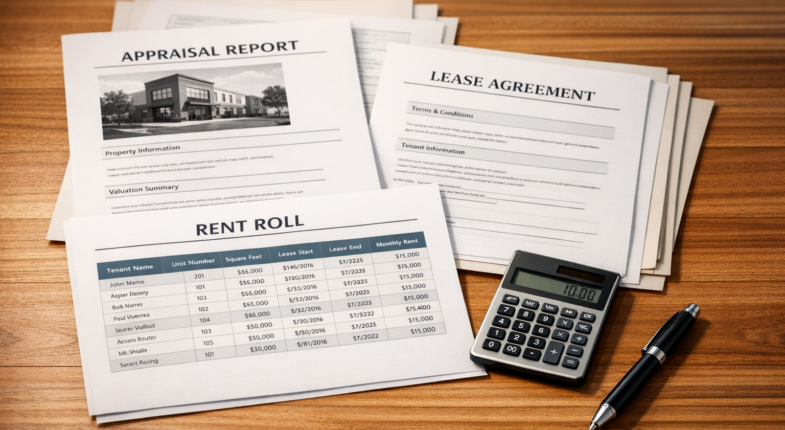
Here is what you’ll want to have ready. A recent appraisal or a well-supported estimate of the property’s value is the starting point. You will also need a payoff statement from your existing first loan so the lender can calculate the combined loan-to-value. If the property has tenants, bring the rent rolls and any active lease agreements too.
Lenders will also want to know the condition of the property. That means any recent inspection reports or an easy summary of known repairs and deferred maintenance. Be ready to explain what you plan to do with the funds because lenders do take that into account.
The most common thing that slows an application down is not knowing the combined LTV before the conversation starts. If your first loan balance plus the new second trust deed exceeds what the lender allows - usually somewhere around 65% of the property’s value - the deal won’t move forward regardless of anything else. Run that math early.

Another thing that trips up borrowers is missing or outdated lease information on income-producing properties. A rent roll from two years ago doesn’t tell the lender what the property is doing, so get a current one.
Here is an easy list of what to pull together before you apply.
Start with a recent appraisal or value estimate. Add a payoff statement for your existing first loan. Include rent rolls and lease agreements if the property has tenants. Gather any property condition reports or maintenance notes. Write out a quick explanation of how you intend to use the loan proceeds.
None of this is difficult to put together, and having it ready not only shows lenders you are serious - it also gives you a cleaner picture of where you stand before anyone else gets involved.
Ready to Pull Equity Without Touching Your First Loan? Here’s Your Next Step
The deals that work tend to share a few common characteristics: healthy combined LTV, a property type lenders actually want to hold, and a structure that gives the second TD lender enough cushion to feel protected. When those pieces align, capital is available - faster than a full refinance and without the rate disruption that comes with replacing a low first. If you’re weighing your options, it helps to understand how a 2nd trust deed compares to a home equity loan before deciding which route fits your timeline.
If you’re sitting on equity in a commercial asset and want to know what’s possible for your situation, EZ Loans is a place to start that conversation. There’s no pressure and no commitment - just an easy evaluation of your property, your existing financing, and whether a commercial second trust deed makes sense for your goals. Investors looking to scale a portfolio using equity loans have found this a useful starting point. Reach out when you’re ready.
FAQs
What is a second trust deed on commercial property?
A second trust deed is a loan secured by a commercial property's equity, recorded behind an existing first loan. The borrower accesses capital without refinancing, and the lender holds a subordinate but legally recorded lien on the property.
What LTV limits apply to commercial second trust deeds?
Most private lenders require the combined loan-to-value of the first and second loans to stay between 50-70%. Going above 65% raises red flags, and most lenders won't approve deals exceeding 70% combined LTV.
Why do fewer lenders offer commercial second position loans?
Commercial second TDs carry higher risk due to subordinate foreclosure exposure, longer legal timelines, and lower property liquidity. Most banks and credit unions avoid them entirely, leaving only specialized private and hard money lenders.
What commercial property types qualify for a second TD?
Retail strip centers, mixed-use buildings, small offices, and light industrial properties are common fits. The key factors are sufficient equity, stable occupancy, and a first loan that leaves room for a second lien.
What documents do I need to apply?
Prepare a recent appraisal, a payoff statement from your existing first loan, current rent rolls and lease agreements, property condition reports, and a brief explanation of how you plan to use the loan proceeds.
Have Questions About Your Situation?
A 15-minute conversation can clarify whether a 2nd trust deed is the right tool for your goals.
Talk to Erik